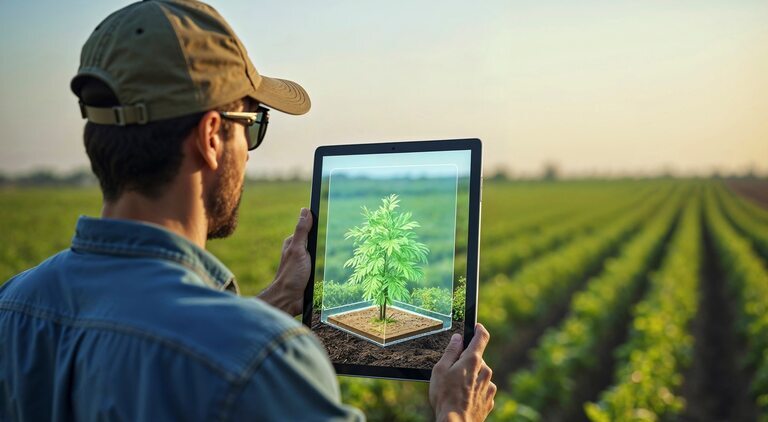
The farming sector in the United Arab Emirates is undergoing a profound transformation driven by automation and artificial intelligence (AI). This change not only focuses on delivering quality food products but also drives better, more efficient and sustainable methods to grow them.
In this blog, we explore the technologies, applications, benefits, drawbacks, and overall role of AI in UAE agriculture, and how businesses like NRTC Group can embrace these advancements.
Technologies Propelling Automation & AI in Agriculture
Farming in arid climates such as the UAE increasingly depends on advanced technologies. Key drivers include:
- IoT sensors, drones, and robotics – According to Intellias, farms now use IoT sensors to measure soil moisture, temperature, nutrient levels, and weather patterns in real time. Drones and autonomous robots support crop monitoring, spraying, weeding, and even harvesting.
- AI and machine learning analytics – At the core of smart agriculture are AI algorithms capable of analysing soil and satellite imagery, predicting yields, detecting pests, and optimising irrigation and fertiliser application. AI processes massive data streams to generate actionable insights rather than simple descriptive reports.
- Automation and autonomous equipment – Agricultural automation includes autonomous tractors, smart irrigation systems, automated greenhouses, and robots that work continuously without fatigue. Intellias notes that autonomous farm technologies are driving productivity and sustainability gains.
- Vertical and controlled-environment farming – Vertical farming and indoor agriculture are expanding rapidly in the UAE’s harsh climate. AI regulates lighting, humidity, and nutrient delivery in these controlled environments, enabling year-round cultivation regardless of external weather conditions.
Applications of AI & Automation in UAE Agriculture
How are these technologies applied on the ground, particularly in the UAE?
- Precision irrigation and soil health management
AI-powered soil analysis evaluates pH, moisture, and fertility to recommend suitable crops and treatments. In water-scarce regions like the UAE, this is essential. AI-driven sensor and weather-forecasting combinations have reduced irrigation water usage by 30–60%.
- Crop monitoring and yield prediction
With drone/satellite imagery and computer vision, AI detects early signs of disease, pest infestation, or crop stress. It also forecasts planting and harvesting windows, as well as expected yields.
- Autonomous operations: from planting to harvesting
Robotic harvesters, autonomous tractors, and drones for seeding and spraying reduce labour dependence and support 24/7 operations.
- Supply-chain and logistics optimisation
Beyond the farm, AI streamlines logistics planning, inventory management, crop-to-market movement, and predictive demand analytics. Generative AI is increasingly used in agribusinesses for forecasting, documentation, and end-to-end process optimisation.
- Smart greenhouses and indoor farming
AI automatically regulates climate, lighting, nutrients, and irrigation to maximise growth—especially valuable in the UAE, where outdoor farming is constrained.
Benefits of AI in Agriculture
- Resource optimisation: AI reduces wasteful use of water, fertilisers, and pesticides while maintaining or improving yields.
- Improved yields and crop quality: Intelligent insights enhance productivity and support effective harvest planning.
- Cost savings and labour efficiency: Automation lowers labour dependency, reduces operational costs, and mitigates labour shortages.
- Environmental and sustainability gains: Smart farming cuts resource consumption, lowers emissions, and promotes sustainable practices—crucial in the UAE.
- Resilience against climate and market disruptions: Enhanced monitoring and forecasting help farms anticipate and mitigate risks.
Challenges for AI & Automation
Despite its promise, AI adoption comes with challenges:
- High upfront costs and technical complexity: Deploying IoT networks, AI systems, and autonomous machines requires investment, expertise, and infrastructure.
- Data connectivity and infrastructure limitations: Remote or desert farms may face connectivity and power challenges.
- Skills shortages and change management: Farmers and agricultural businesses must adapt to new workflows and trust AI-driven decision-making.
- Regulation, data privacy, and standardisation: Farm data collection raises issues of ownership, security, and system interoperability.
- Adaptation to local conditions: AI models trained elsewhere may not directly apply to UAE-specific soil, climate, and crop conditions.
The Role of AI in UAE Agriculture & NRTC Group’s Position
The UAE must overcome arid conditions, water scarcity, limited arable land, and high input costs. AI and automation are becoming essential enablers of sustainable agricultural operations.
For NRTC Group—an organisation that sources, distributes, and supplies agro-inputs and food products across the UAE and GCC—adopting these technologies means:
- Facilitating innovative agritech solutions for farming clients.
- Providing advisory services that connect agro-inputs with sensor, automation, and precision-farming platforms.
- Collaborating with technology providers to introduce IoT, analytics, and automation to partner farms.
- Using AI-driven projections to optimise logistics and improve market alignment.
- Supporting sustainable agriculture by promoting technologies that reduce water, fertiliser, and chemical usage.
By positioning itself at the intersection of technology, farming, and distribution, NRTC Group can accelerate the UAE’s transition to AI-enabled agriculture.
Enhancing Farming Methods with AI Technology
Here are practical ways AI is enhancing farming methods in the UAE:
- Precision water management: AI uses forecasts, soil moisture data, and sensors to irrigate only when and where needed, conserving scarce water.
- Variable-rate fertiliser and pesticide application: AI applies inputs precisely to zones that require them, reducing waste and environmental impact.
- Early disease and pest detection: AI-powered drones identify early stress indicators, enabling timely interventions.
- Yield forecasting and predictive analytics: AI empowers farms and distributors—such as NRTC Group—to plan logistics and market strategies proactively.
- Autonomous greenhouse and vertical-farm management: AI automates climate, lighting, and nutrient delivery for intensive, high-yield production.
- Supply-chain optimisation: AI connects production with real-time demand, reducing wastage and post-harvest losses.
The UAE’s agricultural sector is on the cusp of an AI- and automation-driven transformation. For companies like NRTC Group, the opportunity lies not just in supplying inputs but in enabling a smart agricultural ecosystem where data, technology, and farming intersect. Technologies such as IoT sensors, drones, AI analytics, and autonomous systems are helping improve yields, optimise resource use, and strengthen supply-chain resilience.
However, challenges remain—investment costs, connectivity limitations, skills gaps, and the need for local adaptation. By understanding these dynamics and acting as a bridge between technology providers, farms, and markets, NRTC Group can play a pivotal role in shaping the future of smart farming in the UAE.
As the country moves from conventional practices toward precision agriculture, AI and automation will form the backbone of a more competitive, sustainable, and future-ready agricultural sector.