A quick overview:
Mazraati is NRTC’s first-of-its-kind digital platform, connecting farmers, packhouses, logistics partners, and buyers in one seamless ecosystem — set to truly revolutionize UAE’s Farm-to-Fork supply chain.
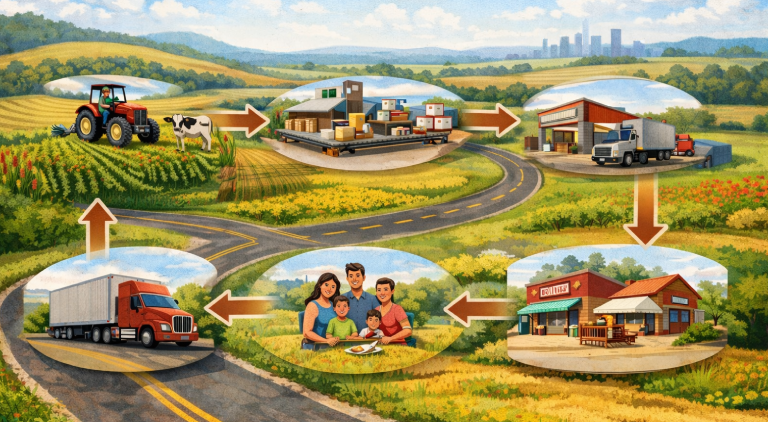
Picture a tomato. It starts its life on a farm in the UAE, gets picked, sorted, boxed, loaded onto a truck, moved through a warehouse, and finally lands on a supermarket shelf or in a restaurant kitchen. Simple enough on paper. But in reality, that journey has long been riddled with blind spots — missing data, temperature fluctuations, manual errors, and a frustrating lack of accountability at every handoff.
Fresh produce gets lost, degraded, or wasted, and nobody knows exactly where things went wrong. That’s the problem we set out to fix with the launch of Mazraati.
What Is Mazraati?
Unveiled at Gulfood Green 2026, Mazraati — Arabic for “my farm” — is a first-of-its-kind Farm-to-Fork digital platform developed by NRTC in partnership with Etheral IT Solutions.
At its core, it’s a single, unified digital ecosystem that connects every stakeholder in the fresh-food value chain: farmers, packhouses, quality-control teams, cold-chain logistics providers, warehouses, and end buyers.
The ambition behind it is straightforward but powerful: give everyone in the chain real-time visibility from the moment produce is harvested to the moment it’s delivered. No more guesswork. No more manual paperwork slowing things down. No more unexplained losses.
A Problem, Decades in the Making
The UAE’s agri-food supply chain has historically been fragmented. Farms, packhouses, logistics companies, and buyers have each operated in their own silos, with limited visibility into what’s happening at the next step. The result? Quality losses, food waste, and inefficiency at scale — all happening quietly, and often repeatedly, because there was no system to catch it.
Mohammed Alrifai, Group CEO of NRTC, put it plainly: “For decades, the Farm-to-Fork model in the region has been constrained by fragmented systems and limited traceability. Mazraati directly addresses these gaps by digitizing the entire journey of produce, starting at the farm and extending through logistics, quality control, and delivery.“
It’s a problem that might sound technical, but its consequences are deeply human — farmers who don’t get fairly compensated because quality disputes can’t be resolved with data, restaurants that struggle to plan menus because they can’t predict stock quality, and consumers who end up with produce that’s past its prime.
Mazraati is built to address all of it – consistently and coherently.
How It Works and Why It’s Different?
Mazraati isn’t just an app — it’s an operational backbone. The platform automates vehicle routing and crate movement, monitors temperature in real time, and manages packhouse receiving through QR-based verification.
When produce is inspected, AI-supported quality grading is applied on the spot, meaning quality decisions are consistent, traceable, and data-backed rather than left to the judgment of any one individual. Transit losses are digitally recorded, creating a clear and honest picture of where things go wrong.
What makes Mazraati particularly thoughtful is how it’s been designed to serve everyone in the chain, not just one party. Farmers gain digital visibility into the quantities they’ve supplied, the quality grades assigned to their produce, and QC outcomes — along with payment tracking that builds trust and removes disputes. Logistics partners benefit from automated route planning, real-time monitoring, and crate-level traceability that makes loss prevention actionable.
And finally, the buyers get early visibility into incoming stock quality and quantities, which transforms how they plan demand and set prices.
The Bigger Picture: Food Security and Sustainability
For a country like the UAE — which imports a significant portion of its food and has made food security a national priority — a platform like Mazraati carries strategic weight beyond supply-chain efficiency.
By strengthening local farm networks and providing the infrastructure to scale them, NRTC is building the kind of resilient, transparent food system that the UAE’s long-term food security goals require.
The platform also captures ESG data at the farm level — tracking environmental and social performance metrics that can support sustainability reporting and responsible sourcing decisions. In a region where corporate sustainability commitments are increasingly scrutinized, this kind of built-in measurement is not a nice-to-have; it’s becoming essential.
We plan to onboard more than 260 farmers onto the platform by 2027, building on its growing network of local farm acquisitions — including Ripe Organic, Mahsool, and other UAE-based production ventures. The breadth of the NRTC ecosystem, which includes entities like Mirak, Al Hashemeya Farms, and Taaza, gives Mazraati a real-world testing ground at a scale that few platforms ever get at launch.
The Road Ahead
The UAE has made remarkable strides in food technology, vertical farming, and agri-innovation over the past decade. But the supply chain connecting local producers to local consumers has often been the weakest link — and the one that’s hardest to fix, because it involves so many different parties with different interests and different systems.
In essence, Mazraati is not just digitizing workflows — it’s redefining how food is cultivated, tracked, distributed, and delivered across the UAE, marking a new era in smart, data-driven agriculture and sustainable supply-chain innovation.
Also Read:
NRTC Group Strengthens Organic Food Leadership with Acquisition of Ripe Organic – https://nrtcgroup.com/nrtc-group-strengthens-organic-food-leadership-with-acquisition-of-ripe-organic/